
FAQ – ALTERNATIVE ASSETS
Hedge funds aim to achieve positive returns at a reduced level of risk. Characteristics making hedge funds unique include the use of derivatives, short selling, leverage etc. to be able to extract positive performance in both upward and downward trending financial markets. Although hedge funds invest in the same asset classes as traditional unit trust funds, they can take advantage of a wide range of price adjustments and thereby generate other sources of return. Hedge Funds tend to have low correlations to traditional portfolios of stocks and bonds, therefore, allocating an exposure to hedge funds can be a good diversifier.
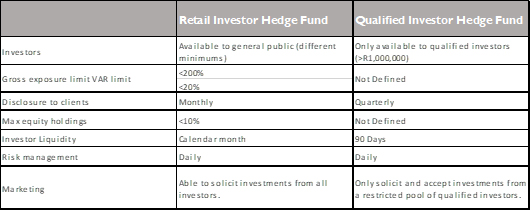
Under the new regulation, CISCA classifies hedge funds into two categories- retail investor funds(RIHF) which have more stringent regulatory requirements, and qualified investor hedge funds(QIHF)
A qualified investor, as defined by the Financial Services Board(FSCA) Board Notice 52 of 2015, is any person who invests a minimum investment amount of R1 million per hedge fund and who –
- Has demonstrable knowledge and experience in financial and business matters which would enable the investor to assess the merits and risks of a hedge fund; or
- Has appointed a Financial Services Provider (FSP) who has demonstrable knowledge and experience to advise the investor regarding the merits and risks of a hedge fund investment.
A retail investor hedge fund is defined as a hedge fund in which any investor may invest because it meets the requirements set out by the FSCA.
Some of the characteristics are tabulated below:
The buying of a security such as stock, commodity or currency, with the expectation that the asset will rise in value.
For example, an owner of shares in Stock Sasol is said to be “long Sasol” or “has a long position in stock Sasol”
For example
Buy 10 Sasol shares @ R100 per share (with the expectation that the asset will rise in value).
Total investment = R100 x 10 = R1000
The share price rises to R135 per share
Portfolio Value = R135 x 10 = R1350
Profit (when selling) = R1350 – R1000 = R1350 = R350/R35 per share
The sale of a borrowed security, commodity or currency with the expectation that the asset will fall in value.
For example, if a manager borrows and sells Stock Sasol, it is said to be “short Sasol” or “has a short position in Stock Sasol”
For example
Borrows 10 Sasol shares and sells on the open market @ R100 per share (with the expectation that the asset will fall in value).
Share price declines to R75 per share
Portfolio Value = R75 x 10 = R750
Profit (when buying back) = R1000 – R750 = R250 = R250/R25 per share
Equity long/short:
Funds aim to generate positive returns by being simultaneously long and short in the equity market. Market risk is reduced while company specific risk is retained. The majority of local equity long/short funds tend to be long biased.
An investing strategy of taking long positions in stocks that are expected to appreciate and short positions in stocks that are expected to decline. A long/short equity strategy seeks to minimize market exposure, while profiting from stock gains in the long positions and price declines in the short positions.
Equity Market Neutral:
Funds take similar sized long and short positions in related equity sectors with that effect that directional market risk is offset.
A strategy undertaken by a manager that seeks to profit from both increasing and decreasing prices. Market-neutral strategies are often attained by taking matching long and short positions in different stocks to benefit from mispricing and delivering positive returns from both the long and the short stock selections and reducing risk from movements in the broad market.
Fixed Income Arbitrage:
An investment strategy that attempts to profit from arbitrage opportunities in interest rate securities. When using a fixed-income arbitrage strategy, the investor assumes opposing positions in the market to take advantage of small price discrepancies while limiting interest rate risk.
This general strategy type includes basis (e.g. cash, futures), yield-curve and credit spread trading, as well as volatility arbitrage.
Statistical arbitrage:
Quantitative models are used to identify market opportunities and establish short-term positions involving a large number of securities.
Volatility arbitrage:
Funds aim to exploit mispricing is the result of different volatility assumptions by price makers.
Commodities:
Funds that predominantly invest in soft or hard commodities. These funds can follow a number of different strategies to obtain alpha from this asset class, including trend following or non-directional market neutral strategies.